On a recent walk I noticed a door within the arch of Marble Arch and idly wondered what it was used for.
Serendipity
Now, because of a small article in The Week about the disbanding of the Royal Parks Constabulary, that led to further articles, I know the answer.
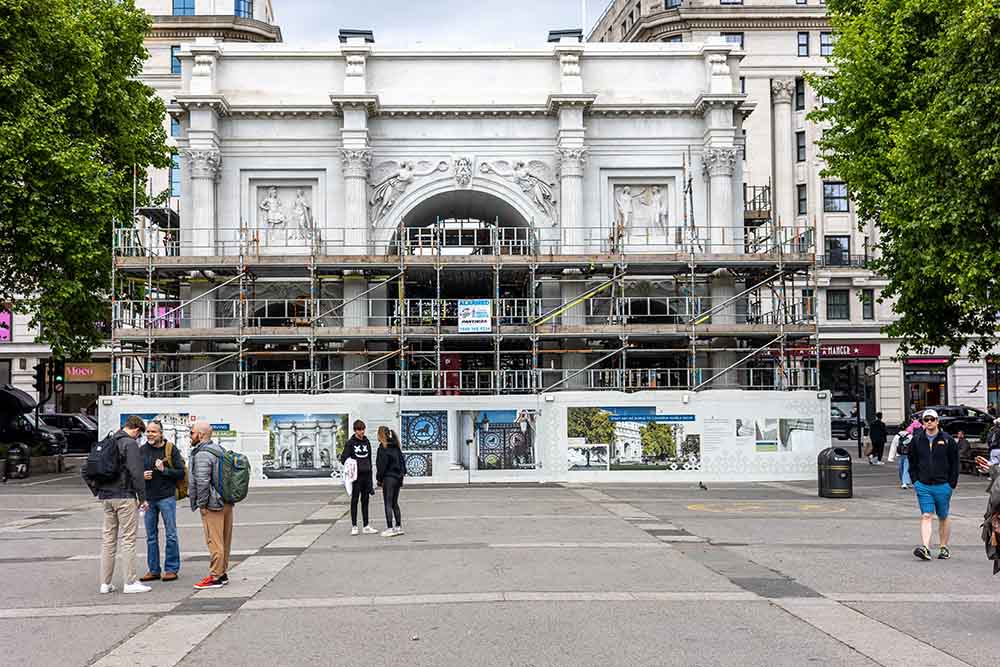
However, when I went today to photograph the door, the Arch was surrounded by a hoarding and scaffolding.
So a photo of the door will have to wait.
The History Of Marble Arch
Marble Arch stands today as one of London’s iconic landmarks, and of course there is Marble Arch Underground Station on the Central Line close by, so travellers are constantly reminded of the name.
The Arch is at the edge of Hyde Park where Oxford Street, Edgware Road and Park Lane meet. Most people know it as a very big structure and very little else. Thousands pass it every day—but few realise it contains rooms that once served as a police station, operating from within the Arch.
The Arch was designed in 1827 by architect John Nash as a ceremonial gateway to Buckingham Palace and a memorial to Britain’s victories in the Napoleonic Wars. Nash’s plans included elaborate sculptures and a large statue of King George IV on top.
However, due to mounting costs and Royal disapproval, Nash was replaced in 1831 by Edward Blore, who simplified the design and removed many of the decorative features. Some of the rejected sculptures were repurposed: the statue of George IV now stands in Trafalgar Square, while other pieces were reused at Buckingham Palace and the National Gallery.
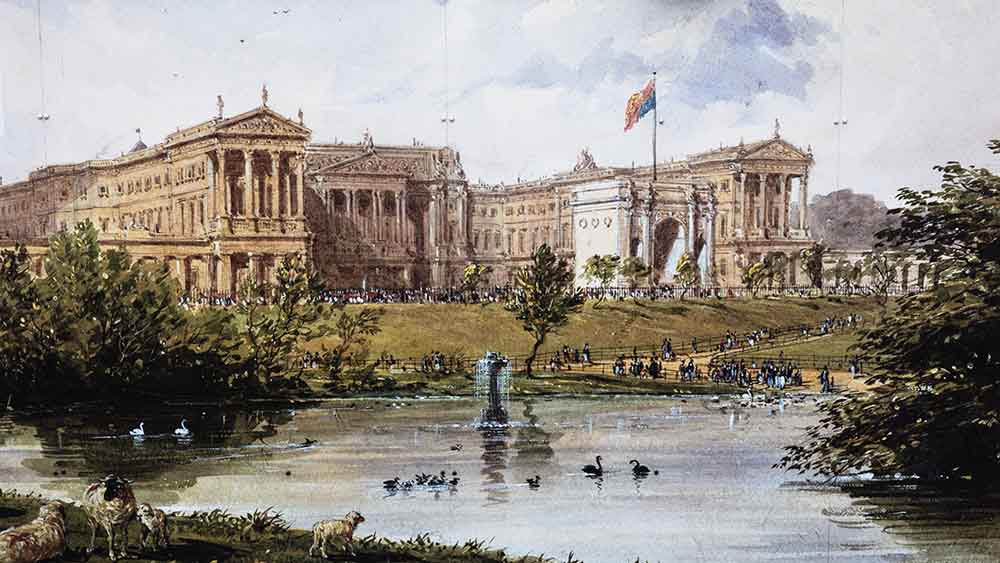
In the 1840s, Blore was commissioned again to expand Buckingham Palace for Queen Victoria and Prince Albert. Marble Arch was overshadowed by the palace’s grand new East Front, so in 1851 the Arch was moved to its current location. During the 20th century, the widening of roads left it isolated on a traffic island, separated from the park .
Yet behind its marble columns and built into the Arch are a number of small rooms, unnoticed by the casual observer. One modest doorway, still there today, once led to the offices of the Royal Parks Police. The use of Marble Arch as a base for police officers stretches back to the days before the RPC was founded.
Before 1872, Hyde Park had its own constables. Some lived in nearby lodges, while others worked out of the rooms inside Marble Arch itself. One of the last inspectors to serve in this early force was Samuel Parkes, a veteran who had been awarded the Victoria Cross for bravery during the Charge of the Light Brigade in 1854, saving a fellow soldier and a trumpet major from charging Cossacks.
In 1872, the Royal Parks Keepers were formed and in 1974 renamed the Royal Parks Constabulary. Unlike most police forces in England and Wales, the RPC reported not to the Home Office, but to the Department for Culture, Media and Sport, through the Royal Parks Agency, a Crown office.
This gave the force a distinct identity. Although not a Home Office force, RPC officers had full police powers within the Royal Parks. Their responsibilities included law enforcement, public safety, and maintaining order across the Royal Parks in London.
An exception was Hyde Park, which because of concerns about disorder, especially at Speaker’s Corner, was the responsibility of the Metropolitan Police from 1867 until 1993. Only in that year did the Royal Parks Constabulary take over its policing. The small rooms inside Marble Arch were used by the RPC until the 1960s, much like those inside Wellington Arch on the opposite side of Hyde Park.
After more than 130 years of service, the Royal Parks Constabulary was formally abolished in England by the Serious Organised Crime and Police Act of 2005. Its responsibilities were handed over to the Metropolitan Police’s Royal Parks Operational Command Unit (OCU). Many former RPC officers either joined this new unit or transferred to the British Transport Police. Despite its reorganisation, the new OCU remained funded by the Royal Parks Agency to ensure park policing remained distinct and protected from budget cuts.
However, on 1 April 2025, Scotland Yard announced that the Royal Parks OCU would be disbanded by 1 November 2025 because of a funding problem. The unit’s 77 officers will be reassigned to other local policing teams.
Restoration Today
Today, Marble Arch is undergoing restoration. As of May 2025, it is surrounded by scaffolding and barriers while conservation experts work to repair damage caused by time, pollution, and climate change. Moisture trapped in the stone expands and contracts with the freeze-thaw cycle, causing cracks. Bronze fittings suffer corrosion, while older cleaning methods have made the marble more porous and vulnerable to staining. Graffiti is harder to remove without damaging the stone, and acidic pollution from traffic continues to erode the surface.
When the restoration is completed, Marble Arch will very probably strike passers by with its clean, white facade as a symbol of national pride in changing times.
Finally here is an illustration of the original location of the Arch outside Buckingham Palace as it was.