Summary: In 1863 insurgents – advocates of an isolationist policy – fired on western vessels, including the Dutch warship Medusa, in the Shimonoseki Straits. In retaliation, the western allies mounted a military expedition to end the blockade. The Netherlands once again deployed HMS Medusa for this mission.
Background
I wrote previously about Ukiyo-e art in Japan and how it had meaning only as long as Japan had only itself to examine. That changed with the opening of Japan by the United States under Commodore Perry that marked the end of the country’s isolationist policies.
What sealed the deal was the power of the American ships. The Japanese knew they could not resist, and so the Japanese government agreed to sign the Treaty of Kanagawa in 1854. That opened two ports to American ships and the establishment of a US consulate in Japan.
Before the arrival of Commodore Perry, the Dutch had limited trade dealings with Japan. I had assumed that it was all smooth sailing.
Visit To The Rijksmuseum in Amsterdam
On a recent visit to the Rijksmuseum in Amsterdam I learned the following:
For centuries the Dutch occupied a special position in Japan.
Since 1639 they had been the only Westerners permitted to conduct trade in Japan. They operated from their trading post on Deshima in Nagasaki Bay. The Dutch were not allowed to leave this small island without permission from the Japanese authorities.
For the Japanese, Deshima represented an important link in their contacts with the Western world. They were primarily interested in Western science and technology. The Japanese rangakusha (‘Hollandologists’) learned the Dutch language and studied Dutch books.
Around the middle of the 19th century, Japan was forced to abandon its isolationism. Under military pressure, a treaty was concluded with the United States in 1854. This was soon followed by treaties with other Western nations, as a result of which the Netherlands lost its exclusive status.
OK, so far so good, in that it fitted with what I already know. But then I learned this too:
Around 1860 Japan was in turmoil about whether or not the country should engage in trade with the West.
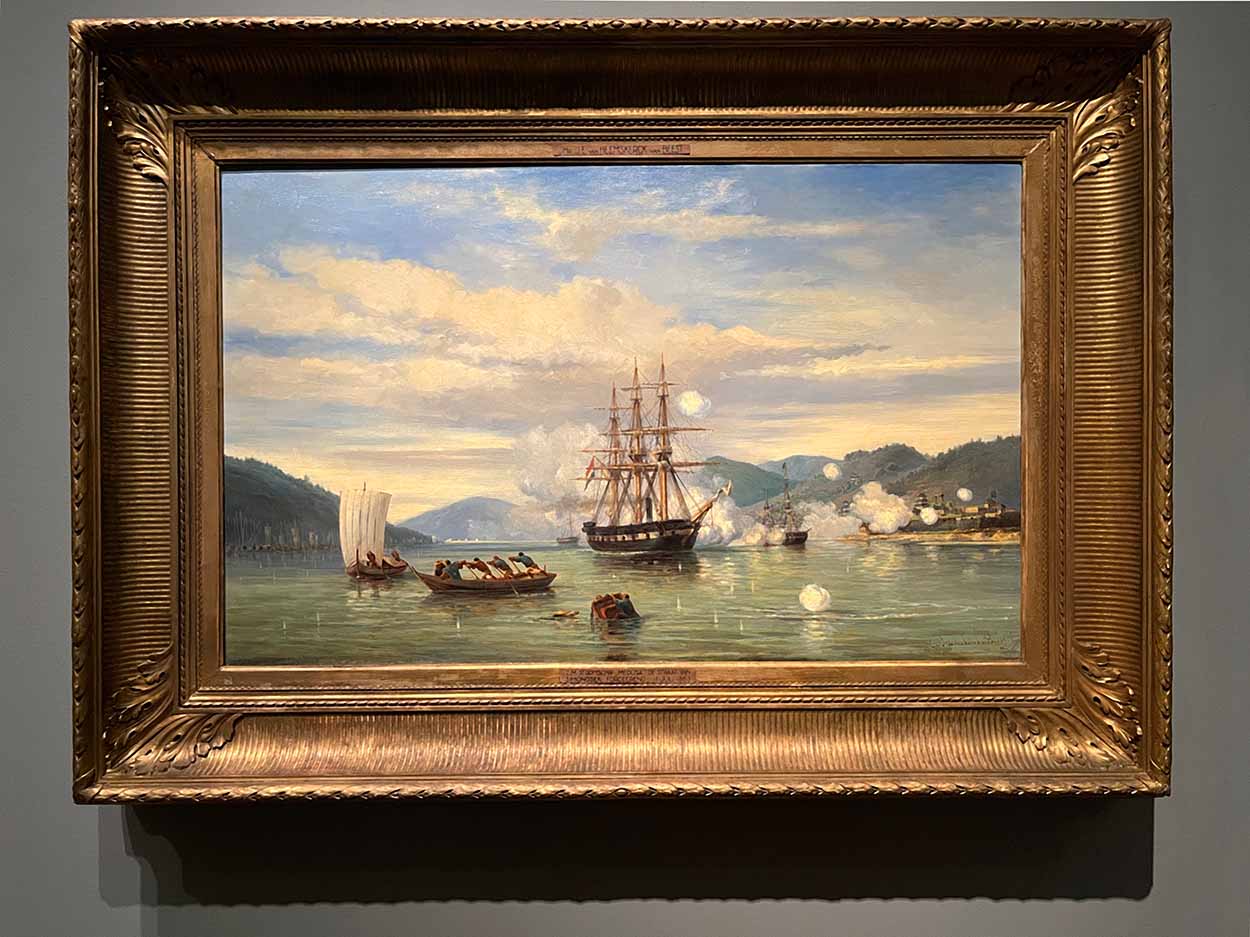
In 1863 insurgents – advocates of an isolationist policy – fired on western vessels, including the Dutch warship Medusa, in the Shimonoseki Straits. In retaliation, the western allies mounted a military expedition to end the blockade. The Netherlands once again deployed HMS Medusa for this mission.
Here is the painting ‘HMS Steam-Powered Battleship Medusa Opening the Shimonoseki Straits’, painted by Jonkheer Jacob Eduard van Heemskerck van Beest (1828-1894) oil on canvas.
Site Of The Naval Battle In The Shimonoseki Straits
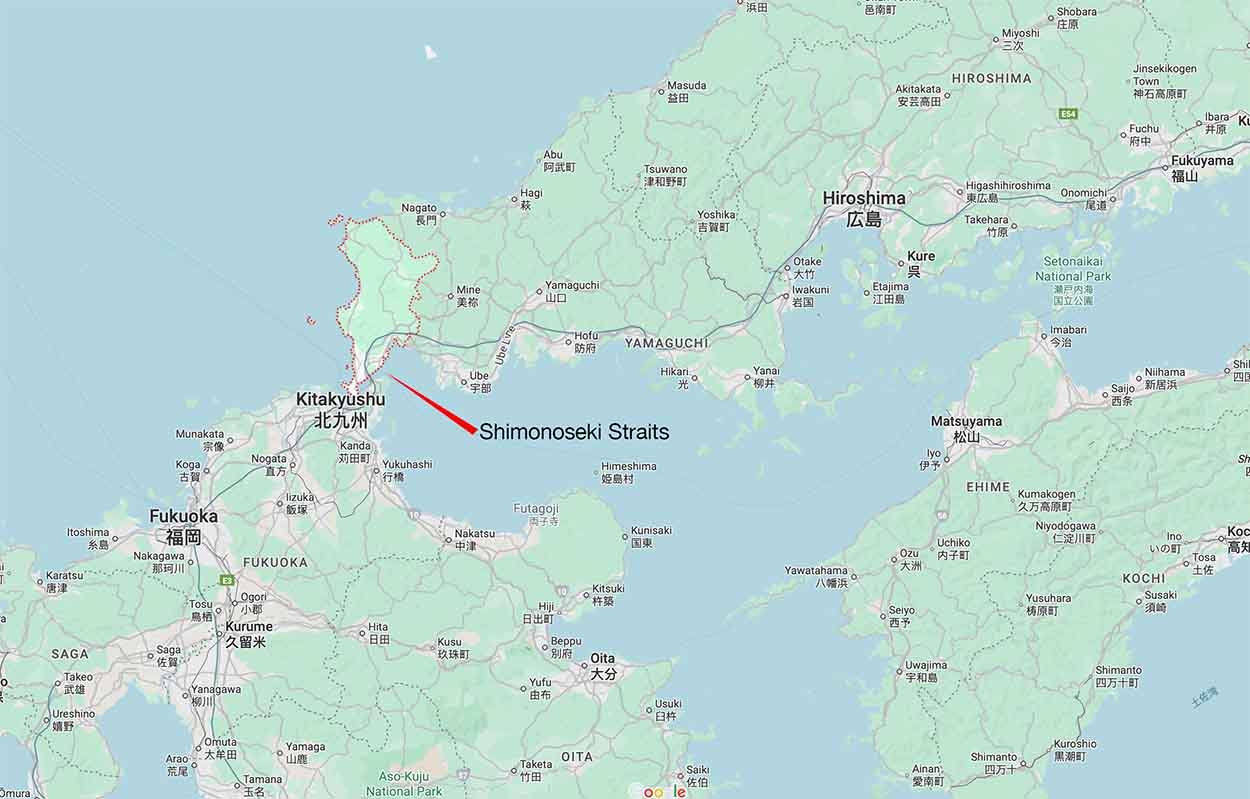
To complete the picture, here is a map showing the Shimonoseki Straits that lie between the islands of Honshu and Kyushu. The straits are also known as the Kanmon Straits, and at some points in the 19th century they were also known as Straits of Van der Capellen.
The straits are an obvious pinch point, being only 650 metres wide at their narrowest point.
Nowadays the straits are important for the short route between the eastern side of Japan and ports in China and Korea.
There’s a car ferry across the straits that takes about ten minutes. There’s also a bridge. And there are several tunnels, one of which carries the Shinkansen bullet train and another that is a pedestrian-only tunnel.