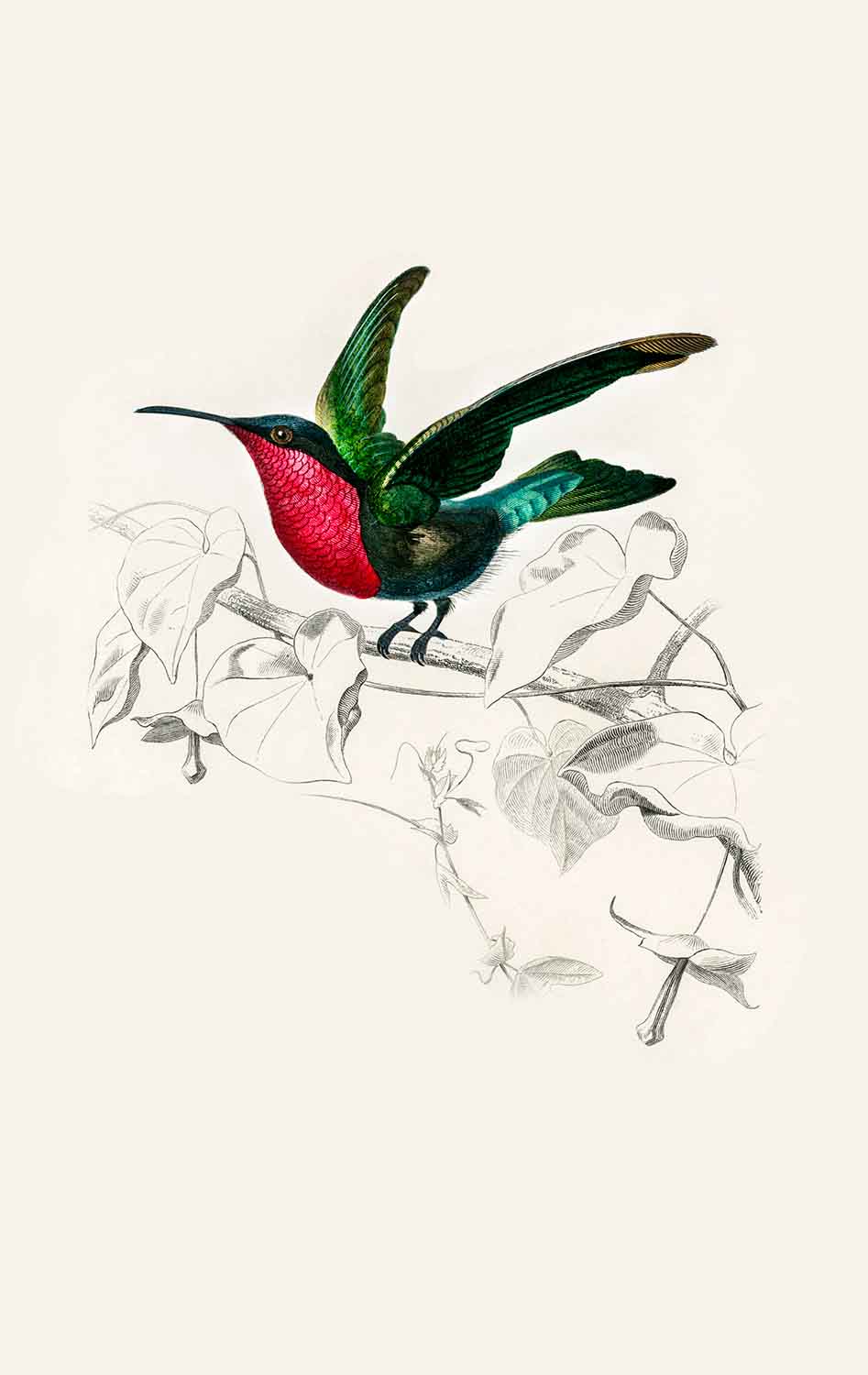
This illustration of Trochilus granatinus or red-throated hummingbird is by Charles Dessalines D’ Orbigny in about 1890.
That might lead to the question of why hummingbirds are called hummingbirds.
The name has been around for a while. In the introduction to his 1861 book ‘The Trochlidae, or family of hummingbirds’. John Gould F.R.S says
THE question has often been asked, whence the term HummingBird has been derived, why the bird is so called. I may state in reply that, owing to the rapid movement of the wings of most of the members of this group, but especially of the smaller species, a vibratory or humming sound is produced while the bird is in the air, which may be heard at the distance of several yards, and that it is from this circumstance that the trivial name by which these birds are known in England has arisen.
So, the Latin name for the hummingbird family is Trochilidae, and it originates from the Greek word trochilos, meaning a small bird. It’s highly unlikely if not impossible that the Ancient Greeks used the word specifically for hummingbirds, since hummingbirds are native only to the Americas and wouldn’t have been known to the Greeks.
But sunbirds in the Old World resemble hummingbirds. Sunbirds are tiny, nectar-feeding, brightly coloured birds and they are found across Africa, the Middle East, and parts of Asia.
Their resemblance to hummingbirds is said to be an example of convergent evolution, where different lineages make similar adaptations even though the species are unrelated. In this case the hovering flight and appetite for nectar is shared by sunbirds and hummingbirds.
So it’s possible the Greeks used trochilos for sunbirds, or perhaps for wrens or other tiny birds.
And then again, maybe they didn’t care too much for fine distinctions. Perhaps any small, darting bird was just “a small bird.”. Perhaps they just weren’t driven to classify everything like we are today.
Trochilidae
Hummingbirds belong to the order Apodiformes, which means ‘footless’ from the Greek a – (without) and pous / podos – (foot).
There are three families in this order: hummingbirds, tree swifts, and swifts.
Of course, these birds do have feet. It’s just that they’re not capable of being used for walking.
Hummingbirds have four toes: three facing forward and one back. Their feet are tiny (no surprise there) and structured in such a way that they can perch but they can’t walk or hop. That’s why you won’t see a hummingbird on the ground.
Tree swifts, like hummingbirds, have one backward-facing toe, allowing them to perch. Swifts, on the other hand, have all four toes facing forward, which suits their near-permanent life in the air.
So who decided that Trochilidae was the right name for hummingbirds?
Nicholas Aylward Vigors coined the name in 1825. Vigors was a prominent figure in early zoology. He co-founded the Zoological Society of London in 1826, and in 1833 he established the organisation that would become the Royal Entomological Society.
Vigors was also a proponent of the now-defunct Quinarian system. It was a 19th-century classification approach that grouped all life into fives – five species per genus, five genera per family, and so on in the belief that nature followed this symmetry.
As evolutionary biology took hold in the mid-1800s, the Quinarian system fell out of favour and was replaced by an evidence-based approach grounded in shared ancestry.
And now we can look back and wonder what the Quinarians thought they were doing trying to shoehorn species into a preconceived belief in pentacle symmetry?
And we could say that the fact that evolutionary biology overtook Quintarianism is evidence that we can learn and we can escape the boxes we make for ourselves. And that is how we move forward.
Still, what beliefs exist today that precede the observations and lead us down wrong alleys because of them?